Forklift Ergonomics: Operator Seat

September 25, 2012

One of the most important assets to your company is your group of dedicated employees and as the employer your goal is to reduce the risk of injury of your employees. Therefore, the comfort and safety of those employees should be a priority.  For forklift operators, the majority of their work day requires sitting for extended periods of time. There are great benefits, for you as the employer as well as the operator, to ensure that this time is as comfortable and safe as possible. Replacing forklift seating with an ergonomic seat is just one of the many ways to accomplish this while also saving you money and time.

Cost to having a poor Operator Seat
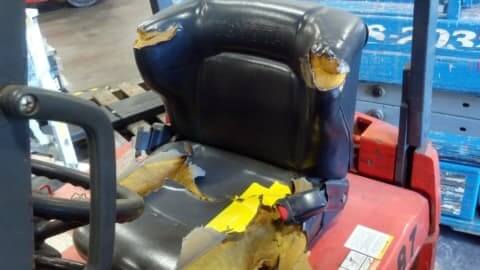
If you notice in your place of business that a forklift has a worn or cheaply-made seating, consider this a sign of danger.  Forklift seating that does not provide proper support for the operator can have serious consequences. The nature of the job for a forklift operator is repetitive. When driving a forklift, operators find themselves in awkward posture positions for long periods of time. In addition, constant vibrations and shock experienced result in uncomfortable work conditions. Functioning under these circumstances over time, an operator can produce varying levels of physical damage from strain, severe pain, to even an inability to work, which is a serious liability for employers to consider.

Benefits to having an Ergonomic Operator Seat
There have been an increasing number of back injuries claims among forklift drivers. Why? Older forklift seats were built with durability as its key design advantage.  New ergonomic seating for a forklift takes into consideration the natural sitting position of the body and develops a design that complements that posture.  With currently advanced technology options (such as lumbar support, back adjustments, and shock damper), the body is kept in its most efficient position.  Other functions of ergonomic seating include:

•           Leg, head, shoulder, and neck protection in case of tip-over

•           Swiveling base for increased visibility and needless twisting

•           Armrests to prevent fatigue

•           Weighted suspension that guarantees comfort for all operators

There are many options of seating to choose from.  The frequency of use, the length of time in use, and whether the majority of use is indoors or outdoors is information to keep in mind when replacing the seat of your lift.

Depending on your selection, a new seat can be a large expense; however, the return on investment is far greater than the initial investment. Maintaining forklift parts save you time and money that would otherwise be put towards potential worker’s compensation claims. Also, finding the right seat for your operator’s work conditions is the key to increasing operator satisfaction, delivering optimum body support, and reducing the risk of injury. 

Click here to learn more about ProLift and our parts capabilities, including forklift operator seats. Our Lift Truck Stuff catalog also features and ergonomic back rest and neck support system.

Inspecting Fork Hooks, Heels & Tips

August 13, 2012

A forklift’s pair of forks has a limited life span and must be inspected daily to ensure safe operation. The inspection should concentrate on three areas – hooks, heels and tips.

Hooks
Hooks are vital welds on a forklift because they are the main source for lifting and carrying product. If a hook on a fork fails, an elevated load can fall and the forklift may tip-over. Before the start of each shift, operators and technicians should inspect each fork on both sides of the hook for cracked welds and separation from the fork upright shank.

Heels
Fork heels should be visually inspected each day for cracks. When a load is applied, the forks flex and microscopic cracks are produced in the metal. Over time the metal fatigues and the cracks become larger.

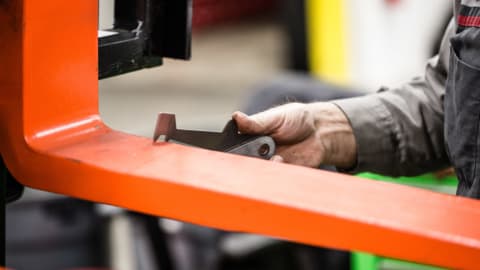
Heel thickness is decreased when the heel of a fork is dragged on the floor, especially on rough surfaces such as concrete or blacktop. The heel thickness can be measured with a fork caliper and compared to the fork upright shank thickness. The mast chains and tire wear should also be inspected. If either of these components is worn beyond their useful life, forks might drag.

Tips
Damaged fork tips can cause operator frustration due to loads not properly engaging and disengaging. Fork tips are subject to damage if they are abused to nudge loads into position or hit walls and posts. Fork tips should also be measured with a fork caliper. Per ANSI the tip height of deflection in a set of forks cannot exceed 3% of the length of the blade. A 42” fork set has approximately 1” tip height difference allowed before repair or replacement is required.
The described inspections are daily visual inspections and are applicable to most fork designs; however, forks can be application specific and require different inspection points and standards. More detailed inspections are required by ANSI standards on an annual basis.

Time to replace your forks? Call ProLift today to speak to a consultant or click here to learn more about our Parts capabilities.

Should You Consider Rebuilt Parts?

June 22, 2012

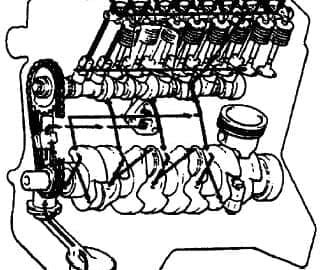
As a forklift ages, parts must be replaced to keep your unit running at peak performance. When the part is an integral part for the forklift (i.e. starter, engine, alternator, cylinder, steering axles, drive motors and transmissions) the expense can greatly decrease your annual maintenance budget. Rebuilt parts can provide a better value and should be a consideration.

What is a rebuilt part?
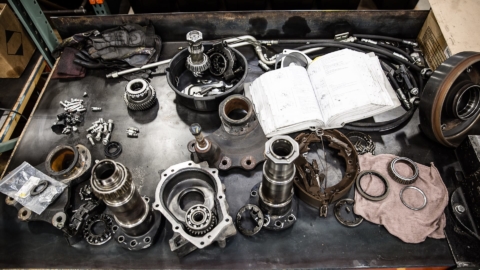
Main assemblies are comprised of multiple components. If one of the pieces breaks, it can cause the part to malfunction and shut down your forklift. When a part is rebuilt, it is taken apart to locate the worn piece, which is replaced. It is then cleaned and reassembled for resale.

How trustworthy is the source?
Because each source adheres to a unique set of standards, asking how the part was rebuilt will help you build trust with the supplier. Some sources replace only the failed part. Others may provide remanufactured parts. A remanufactured part has replaced the worn piece as well as any normal wear item(s). Learn if the part is engineered to the Original Equipment (OE) drawing and where the failed part was located (new unit, salvaged yard unit).

What if the rebuilt part fails?
Like new parts, rebuilt parts should be backed by the supplier’s warranty. Your supplier should also be aware of the sources’ overall reputation and parts failure rate.

Can you help my older forklift?
Based on the unit’s age and hours, the supplier can advise if a rebuilt part will be durable for your application. A light to average application lends itself to rebuilding your forklift’s part when finding a replacement isn’t an option.

How will my company benefit?
Short-term you will benefit from a cost-savings for the replacement part – up to 50%. If the supplier can source a rebuilt part (rather than use the original from your forklift) the unit’s downtime will decrease. Rebuilt parts also benefit the environment by eliminating the need to produce a new part.

When you have a forklift down, contact ProLift to get it running. We guarantee service within 4 hours and to supply the parts you need. Visit our website to learn more about our Customer Commitment.

Evaluating Your Forklift Tires

May 21, 2012

It’s easy to assume forklift tire maintenance will be manageable and budget-friendly; however, unless the tire experiences major damage, its replacement is often overlooked. To help you make an informed decision, this article highlights common issues concerning forklift tires.

Chunking
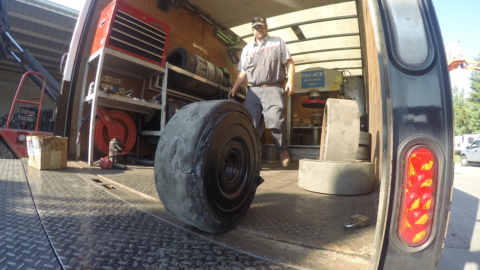
When a forklift tire loses part of its tread, this is called chunking. Forklift tires are vulnerable to chunking when driven over dock plates or debris in the facility that can tear pieces off the tire. Many tires are replaced prematurely due to chunking, causing unplanned maintenance expenses.

Oils & Solvents
If your facility has an application involving cutting oils and solvents, forklift tires can be at risk for damage. If the tire repeatedly comes into contact with these chemicals, over time it will soften, making it more vulnerable to chunking.

Safety & Fatigue
Damaged forklift tires bounce the operator. This can lead to fatigue and decreased production. Tires with chunking also decrease the stability of the forklift and can contribute to a tip-over.

Damage to the Forklift
Wearing down forklift tires beyond their useful life is another reason for replacement. In these cases, the forklift’s forks and mast are at risk for damage. Because the forks and mast will sit lower to the ground, they will be prone to come into contact with the facility floor or impact the dock plate. This can lead to a costly replacement of these components as well as damage to your facility.

Getting an Evaluation
Getting an outside perspective also helps you find solutions for your forklift tires rather than accept the ongoing damage. A consultant can discuss your facility layout, application and tire expectations to find the best fit for your fleet.

ProLift offers a complimentary forklift tire evaluation. This evaluation includes a consultant reviewing each unit in the fleet to measure the remaining tread on the tire. Results will highlight tires that need immediate tire replacement. Predicted replacement dates of other tires will also be noted to assist you with budgeting. If your tire is not suited for the application, our consultant will also share tire options.

Contact ProLift today to schedule your complimentary tire evaluation! Or, click here to learn more about our tire capabilities, including on-site tire pressing.

Forklift Safety: Can You Remove the Forklift’s Load Backrest?

January 12, 2012

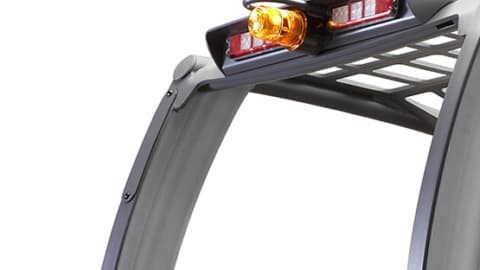
The load backrest can be the highest point of the forklift. Trailer tops, rack systems, lights, HVAC, sprinkler systems and other overhead obstructions come in contact with load backrests.

If an object above the forklift gets hit, do you blame the load backrest … or the operator?
To put another spin on this question, if a co-worker said “I keep backing into things with the bumper on my pick-up truck”, would you suggest removing the bumper? Or would you mention to your co-worker that he or she needs to be more alert to hazards near the pick-up truck?

Many times the answer to a customer’s question about removing the load backrest is “Yes, remove it and remind your forklift operators to be careful.” But, this is not an accurate answer representing OSHA’s code of federal regulations? (*See below)

The answer is a conditional “yes”. All loads handled by the forklift and the facility it operates within must meet one of the requirements below:

1)      All loads do not go higher than the top of the forks.

2)      All loads are one piece, shrink wrapped, banded or crated.

3)      No loads in the facility are stacked or racked higher than the operator’s head that does not meet the load requirements above. Lift trucks with the load backrest removed must be restricted to handling only loads meeting the requirements above or is restricted to a specific area of the facility that does not contain any loads presenting a hazard.

Provide safe operations while meeting OSHA requirements
Forklift manufacturers offer various heights for the load backrest. When selecting a lift truck, research the warehouse application and the heights of loads to purchase load backrests that meet rather than exceed the requirements. The proper load backrest will provide protection for the forklift operator while reducing the possibility of product and facility damage.

Other solutions include shrink wrapping or banding the loads and restricting a forklift with a removed load backrest to specific areas (i.e. the dock for loading and unloading trailers).

Do you have employees in need of lift truck safety training or pedestrian awareness? Contact ProLift to discuss available training and dates.


* Federal Regulations

OSHA CFR1910.178(e)(2)
Safety Guards: If the type of load presents a hazard, the user shall equip fork trucks with a vertical load backrest extension.

OSHA CFR1910.178(m)(10)
Truck Operations: A load backrest extension shall be used whenever necessary to minimize the possibility of the load or part of it from falling rearward.

OSHA CFR1910.178(q)(6)
Maintenance of Industrial Trucks: Industrial trucks shall not be altered … either by the addition of extra parts … or by the elimination of any parts.


Forklift Tire Replacement: Bad Forklift Tires Equal a Bad Ride

November 10, 2011

When addressing concerns about your company’s forklift tires, you can feel as much despair as the little boy in the picture. More than frustration, bad forklift tires can be a serious safety issue that can create stability issues for the truck and its load.

Forklifts do not utilize suspension systems with springs or air-ride similar to over the road trucks. They use a suspension system much like a farm tractor. The front axle is solid mounted in the frame of the truck. The rear axle is mounted on a pin in the center of the axle. This design allows the solid front axle to stay in contact with uneven surfaces as the rear axle pivots in the center. The only cushion or yield your operator has between the ground and his or her lift is the rubber or air of the forklift tire.

Bad forklift tires equal a bad ride. A bad ride results in upset operators and loads, increased maintenance costs, damaged facilities and possible forklift stability issues.

Operators who endure the operation of a forklift with chunked, worn or flat spotted tires have increased fatigue and job stress, possibly making them angry, disagreeable and unproductive employees. If an operator is not focused on his or her operation, there can be serious ramifications to everyone’s safety.

Forklifts subjected to deficient tires increase exponentially in maintenance costs. A lack of tread initiates spinning of the tire and more turns to cover the given distance, causing increased heat, wear on the transmission and increased fuel costs. Decreased ground clearances subject the truck to more damage to assemblies underneath. Having little to no cushion from worn forklift tires loosens hardware on the unit which can cause engines and transmissions to leak. Fork heel wear is accelerated as it becomes easier for an operator to drag the forks. Battery cycle time can be affected on electric lifts.

Loads can be compromised by the constant jarring and rocking, leading to damaged product and safety issues such as an upset forklift load falling on an employee.

Your facility can experience damage due to bad forklift tires. A lack of tread can cause operators to lose control of the forklift, hitting production machines, door frames, racks and walls. Accidents can damage dock and bridge plates, blacktop or concrete.

Stability of a forklift can be affected by the condition of the tires and air pressure. When solid rubber tires wear excessively on one axle, it changes the tilt angle of the mast. The severe change in maximum tilt angle can create tip-over or loss of the load. Air filled forklift tires with damaged sidewalls or tread are also at risk for tip-over and damaged product if a tire suddenly blows or low air pressure creates an unstable forklift that leans when loaded.

To ensure your company’s forklift tires are not worn, regularly inspect them for loss of tread, signs of separation from its band or damage. Cushion forklift tires should be measured to determine the height of the tire. An industry standard is replacing the forklift tire when it reaches just above the imprinted area with the brand name and size of the tire. For pneumatic forklifts, inspect the tires for cracks, splits or little tread.


Interested in a complimentary forklift tire inspection? Contact ProLift to request an on-site tire application survey. Or, click here to learn about our comprehensive industrial tire inventory.

Safety Accessories for Your Forklift

September 23, 2011

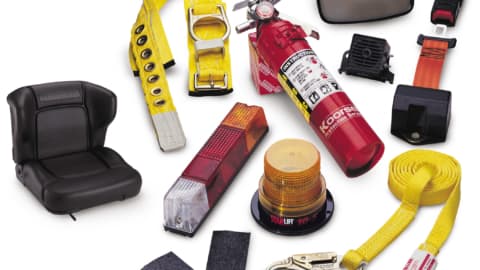
A forklift operator has a responsibility to be aware of pedestrians and other operators. In a busy warehouse this is not an easy task. To help keep their employees safe, many companies are investing in safety accessories for their forklifts, such as mirrors, back-up alarms, strobe lights and fire extinguishers.

Mirrors are affordable, easy to install and can be placed either indoors or outdoors. A benefit of having a mirror for a forklift operator is the decrease in physical strain on the body and neck as he or she attempts to watch all sides of the path. Most importantly, the wide angle views and capability to see blind spots can prevent a collision with other forklifts and pedestrians.

Back-up alarms are installed to alert others that a forklift is near, adding a sound dimension beyond the forklift’s horn. If the level of noise varies in the work environment, a “smart alarm” option gives flexibility by listening to the surroundings and adjusting the decibel level accordingly. Although the option is not required by federal law, if the forklift is manufactured with a back-up alarm it must be kept in working condition and never disconnected.

Strobe lights are flashing lights used as a visual cue to pedestrians and other operators that a forklift is approaching. To be effective, the strobe light must be seen by workers and like the back-up alarm, it must be kept in working condition if the forklift is manufactured with the option.

Fire extinguishers are not a required feature on a forklift; however, the work environment is the key factor when determining its placement. Forklifts can be considered a source of ignition. If the work environment includes flammable material, it provides the forklift operator additional protection.

When placed in the proper warehouse atmosphere, safety accessories can be effective for accident prevention; however, they should never replace the use of horns, spotters or areas restricted to pedestrian traffic. And because an accessory is only as effective as the person using it, advantages of using the safety accessory should be stressed to those conducting pre-shift forklift inspections and operating the forklift.

Think a safety accessory is right for your forklift and warehouse application? Answer our 11 questions to learn the best accessory to put in place or click here to review our online product catalog.


11 questions to ask when considering safety accessories:

  1. Could a safety accessory have prevented a recent accident?
  2. Are blind spots prevalent throughout the warehouse or in a specific area?
  3. Have operators complained of neck strain?
  4. Do operators frequently forget to sound the forklift’s horn?
  5. Is the warehouse well lit?
  6. Are forklifts used primarily in daylight?
  7. Is the warehouse very large or small, causing sounds to be distant or overwhelming?
  8. Is the warehouse naturally noisy?
  9. Would a back-up alarm potentially cause hearing loss?
  10. Are forklifts operated near flammable materials?
  11. Were the forklifts manufactured with a safety accessory?

What You Should Know Before Buying Forklift Parts

July 22, 2011

Just as you will have to replace filters and tires on your personal vehicle, your company will have to invest in forklift replacement parts. The parts placed on your lift will play a factor in keeping production on schedule and your employees safe.

What should you consider?

Know the make and model of your lift
This basic information will ensure you get the right lift part the first time. It also prevents the wrong forklift part from being installed, which can lead to a lift failure or an accident.

Put quality before cost
While it is good to know your budget, do not buy the cheapest part without considering the overall cost to your bottom line. If the cheaper part wears out quicker and must be replaced more often, you haven’t saved money. Plus your forklift has experienced more downtime. Lost production of associates and trucks waiting on the line is often far more expensive than the cost of repairing the forklift.

Ask about alternate forklift parts
When working with a forklift dealer, a Parts Specialist’s knowledge is invaluable. Ask if another forklift part is an option. You may find another quality part that is more cost effective or a rebuilt part may be available. The Parts Specialist may also be able to advise if replacing other parts would be beneficial to the operation of the lift (i.e. water pump, gasket, fan belts, thermostat, etc).

Know the delivery schedule
If your forklift isn’t operating, having the part becomes an immediate need. During your search, ask the source if the forklift part is in stock and can be shipped right away or picked up. If the part must be ordered, confirm the arrival date is acceptable to your production schedule.

Be aware of the warranty
Is the forklift part covered under warranty and if so, how long? Although most reputable manufacturers strive for 100% quality, a warranty offers security in the event a part quickly breaks.

Inquire about extra service
When working with a forklift dealer, many offer the service of installing the part. If your company doesn’t have an in-house technician, having an expert put on the forklift part offers additional security. In some cases, the labor to install the part is also under warranty.